
UX & Interaction designer | UI designer | Team project
How can we give an online city a sense of identity and belonging?
City of Lunaria is a not-for-profit virtual city working towards creating a more sustainable future, both environmentally and socially by working outside of today's recognised country borders.
A collaboration between City of Lunaria and master students of Interaction Design program at Malmö University took place between 19 January and 24 March 2023. Lunaria was represented by the following case stakeholders: Steven Kainth (Founder & Caretaker, Lunaria), Hayley Ard (Lead, Human Insights and resident mental health expert, Lunaria), Evgen Zelenski (UX designer, Lunaria) and Thomas Bartle (Business Manager Ray Ban, Luxottica). Malmö University was represented by Gianmarco Gradellini, Agustin Guerrero and Eugenia Mazanik.
Weekly meetings were organised in order to ensure a successful collaboration. Different types of activities were performed with the stakeholders: process check-ins, presentations, discussions and co-design workshops. Additional contact was kept during the week via email and Whatsapp.
A choice of 4 topic options to work with was presented to us:
- Preventive healthcare and digital pharmaceutics
- Teaching and learning environments
- Flag and identity
- Personal development
After long deliberation we made a decision to propose another option for a topic to stakeholders: Citizenship. The idea came from a discussion of a future feature of Lunaria, an electronic residence (E-Residence). The core idea is to create a sense of unity and community on Lunaria and developing the idea of Lunaria citizenship would play really well into it.
After conducting the initial research and considering different aspects of citizenship, we felt the need to narrow down the field of action and settled for the theme of flag and identity. The following questions were raised for discussion at the next part of the discovery stage:
- What makes Lunaria a city?
- How can an interactive flag become an important part of a community identity?
During the discovery stage two workshops were conducted.
For the first workshop students conducted semi-structured interviews with the stakeholders. Each would respond to the questions individually and then have a group discussion, bringing up their answers. The intention was to discover the views they had for what Lunaria would become, discuss potential challenges they might foresee and bring up possible dissonances among the different stakeholders’ view.
For the second workshop students conducted semi-structured interviews with thirteen students of Malmö University. Most of the students were target users for Lunaria (ages 16-25) and some of them were studying at the Leadership for Sustainability master program, which made their participation especially valuable as Lunaria has a strong focus on sustainability. The students would take turns to respond to the questions in front of the others, sparking discussion between opposing ideas and values. The intention was to understand the target user’s concerns and core values, seeing if they align with the idea behind Lunaria, and finally, bring up the needs and wants of the users in contrast with the ideals of Lunaria, as Lunaria had yet not done any user research. We immediately noticed some confusion around these crucial themes and some conflicts arose between the contrasting points of view of the different stakeholders. When asked what Lunaria was, indeed, the conversation was often deflected on ideals, intentions, utopian scenarios and never actually on what was already available on the webpage. Through further questioning and interpreting, we concluded that Lunaria was still in a very early stage, where the webpage was simply a collection of different brands that declared to be ‘striving for good’. The user, therefore, could visit the webpage, navigate through the different shopping categories (i.e. Fashion, Skincare, Travel, etc.) and be directed to a brand’s website. There were at the time no other functions available.
After that, a thorough research on flags was conducted: both traditional and virtual ones. The conclusion was made that virtual flags and dynamic logos are very few yet, which opens up a good opportunity for developing such an idea. In order to explore this thought further, a 1 week long cultural probe was conducted. 11 participants were asked to produce a media that represents their personal identity with the intention to understand the target users’ ways of expressing themselves in order to demonstrate their values, interests, etc. It was followed by a discussion of different options of data that could be represented by the flag (e.g. CO2 emissions, number of people currently on Lunaria, people participating in certain activities, services available, section a person is currently in, user’s personal interests, number of brands represented by Lunaria, products, donations for environmental causes, etc.) and its potential positioning (e.g. flag on the top of the buildings in Lunaria, top bar of the website, random location, on user picture, etc.).
The cultural probe activity allowed for gathering additional inspiration and ideas and was followed by sketching and low-fidelity prototyping of an interactive flag for Lunaria using Figma and Photoshop, and included a discussion on how interactivity of the flag could be activated (e.g. by shaking or rotating the phone, blowing the air into the microphone, cursor moving, etc.).
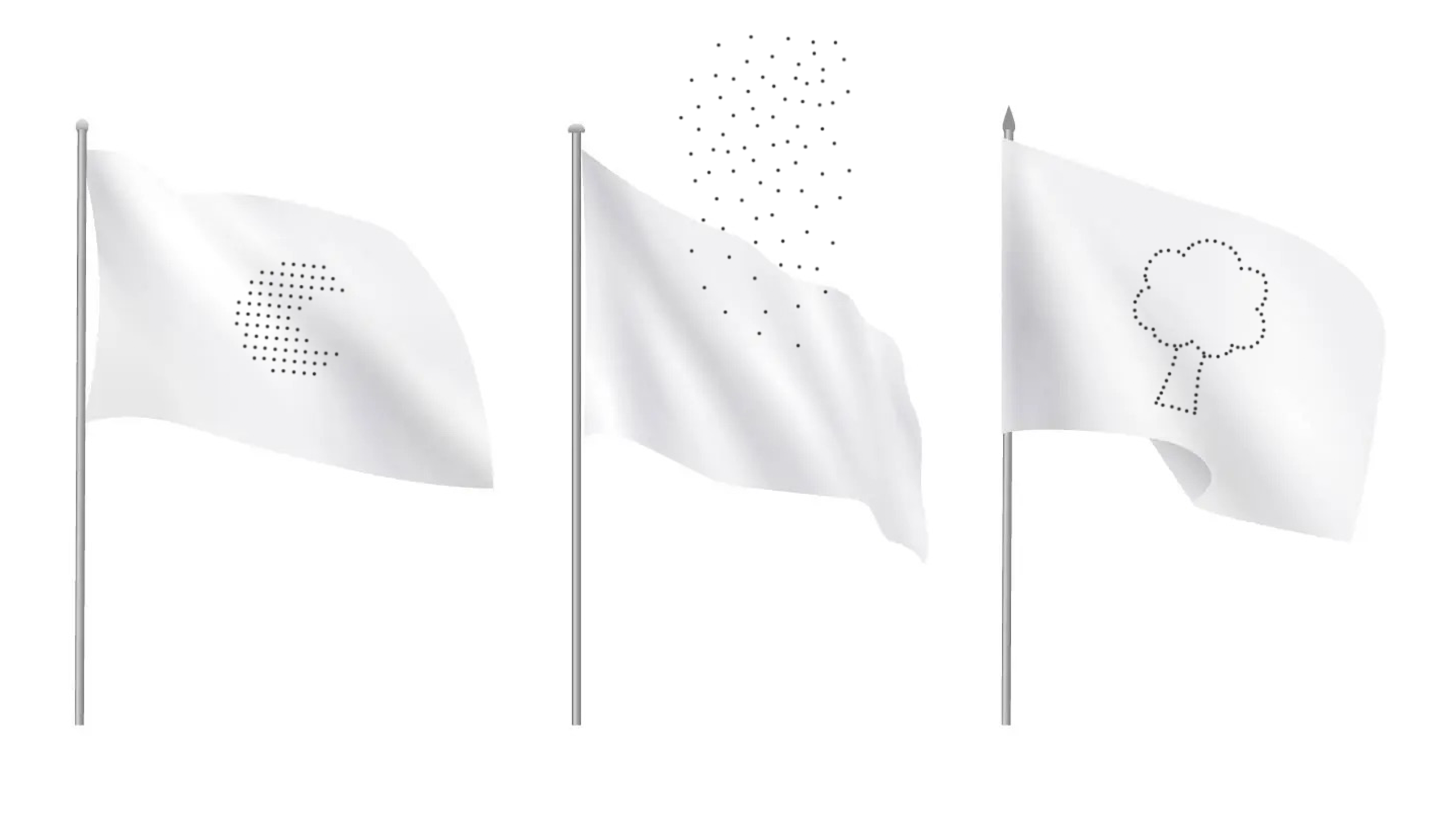
The animation of the flag was proposed as an option and explored further. Logo of Lunaria consists of the dots which inspired the idea of allowing for movement and combination of the dots as a part of the interactive flag (including options of QR-code, NFT, etc.)
The design that was handed over to Lunaria consists of different options of how a digital interactive flag for City of Lunaria could work and look like. We decided to use moving dots to be coherent with Lunaria’s logo and because the dots moving together to create new meaning strongly symbolises Lunaria’s aim to create a compact community of individuals working together towards a common goal.
To help us foster a more transparent and concrete conversation about City of Lunaria, its community and its concept of citizenship we decided to start working on the creation of a flag for Lunaria as a boundary object to aid discussion. According to Susan Leigh Star and James R. Griesemer, a boundary object is defined as “an object that lives in multiple social worlds and which has different identities in each”. In our case, the flag has a symbolic meaning when it is referred to the Lunaria community where it entails the feeling of belonging and has a strong metaphorical value. It has, however, a completely different meaning and identity when it comes to the commercial uses it serves; here, in fact, it is not considered in light of its symbolism but as a mean for commercial and marketing operations to create a recognisable brand identity. It has therefore been a useful instrument to concretely discuss the conflict between ideals and economic interests inside the project.
Particularly useful for this purpose has been the work of Peter Dalsgaard et al. on defining emergent boundary objects. These are a particular category of boundary objects “whose structure and meaning is not yet stable”; they address design concepts, understood as more or less well-developed ideas and concepts about what the product of a design process may become, adding a processual perspective to the established concept of boundary objects. The flag was, as a matter of fact, not just a static object, but rather a constantly evolving concept that was shaped by the conversation around it. This allowed us to explore different ideas and possibilities, and to find a way to reconcile conflicting interests and values.
What distinguishes a flag from a logo in a digital context? According to the stakeholders, “they’re very similar, it’s just the meaning of the word that changes. […] it’s a matter of identity; you can separate from a logo but not from a flag, it will always be part of your identity. A flag is more universal, it has no words on it, it’s inclusive and more multifaceted than a logo. One can take off a t-shirt with a brand logo on and not be committed to that logo anymore”. This meaningful separation, though, loses strength when proposals like selling the flag as NFTs or using it as a QR code to support the “bring a friend” dynamic are brought into the discussion.
Hello there! Thank you for visiting my portfolio. I'm thrilled that you've taken the time to explore my work. If you have any questions, comments, or even just want to say hello, feel free to reach out to me using the form below. I'd love to hear from you and learn more about your thoughts on my projects. Whether you're interested in collaborating, have an exciting opportunity, or simply want to connect, I'm here and ready to chat. Looking forward to our conversation and the possibility of working together. Don't hesitate to drop me a line!


